
Compare die casting quotes by normalizing the finished scope, quantity and acceptance conditions. A cheaper unit price can represent an unfinished casting, a different alloy or an excluded inspection operation rather than a more efficient route.
Build a comparison sheet before ranking prices
| Quote item | Normalize | Common difference to resolve |
|---|---|---|
| Drawing and model | Same revision and exceptions | One supplier excludes a critical feature |
| Material | Grade, standard and approved alternatives | Generic aluminum versus specified alloy |
| Delivered state | Machining, finish, marking and packaging | Raw casting versus finished component |
| Tooling | Die, trim tools, fixtures and gauges | Separate or omitted setup items |
| Quality | Reports, traceability and functional tests | Different sampling or test coverage |
| Delivery | Quantity, cadence and delivery term | Freight, tax or inventory boundary |
Record every exception explicitly. A supplier that cannot meet a required condition should not receive an apparent price advantage because the missing operation is invisible in the spreadsheet.
Separate fixed cost from recurring cost
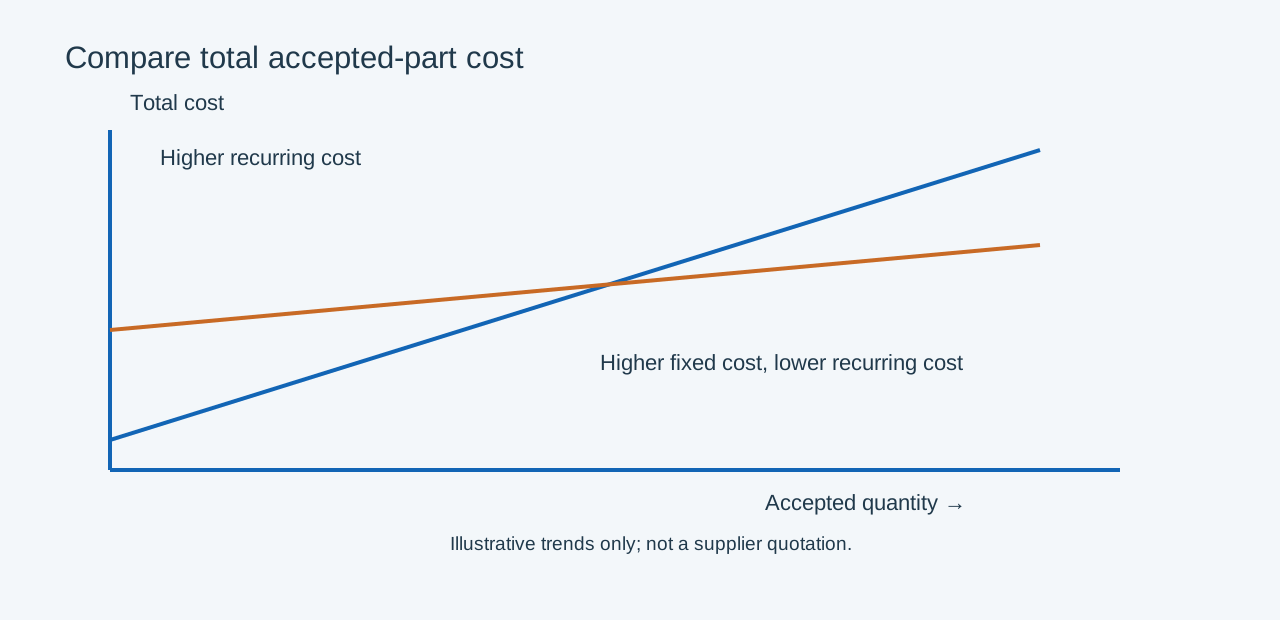
Use a common demand scenario to calculate total cost. For an illustrative comparison, offer A charges $20,000 fixed and $12 per finished accepted part; offer B charges $30,000 fixed and $10 per part. At 2,000 parts, A totals $44,000 and B $50,000. At 10,000 parts, A totals $140,000 and B $130,000. These invented figures show why order horizon changes the result.
Check where tooling maintenance, correction and replacement sit in that model. Establish whether the quotation includes sample iterations and what triggers additional charges. Do not count the same amortized tooling cost twice.
Compare feasibility and evidence
Ask each supplier to explain the proposed casting, machining and finishing sequence, critical risks and sample-acceptance plan. Capacity should be discussed for the complete route, including bottleneck machining and finishing. A machine tonnage or a list of equipment does not establish delivered capacity for the specific part.
Use a common clarification log and request revised offers where scope changes materially. Select against the agreed technical and commercial requirements. A normalized quotation is easier to approve and gives the production team a clearer record of what the price actually covers.
Related engineering decisions
- Calculating the Break-Even Quantity for Die Casting
- How to Choose a Die Casting Supplier
- Related manufacturing service
- Read the broader engineering guide