
A380 and ADC12 are familiar aluminum die-casting designations, but a material cross-reference is not permission to substitute one for the other. Procurement should start with the controlling specification, chemistry limits and finished-part requirements.
Resolve what the drawing actually specifies
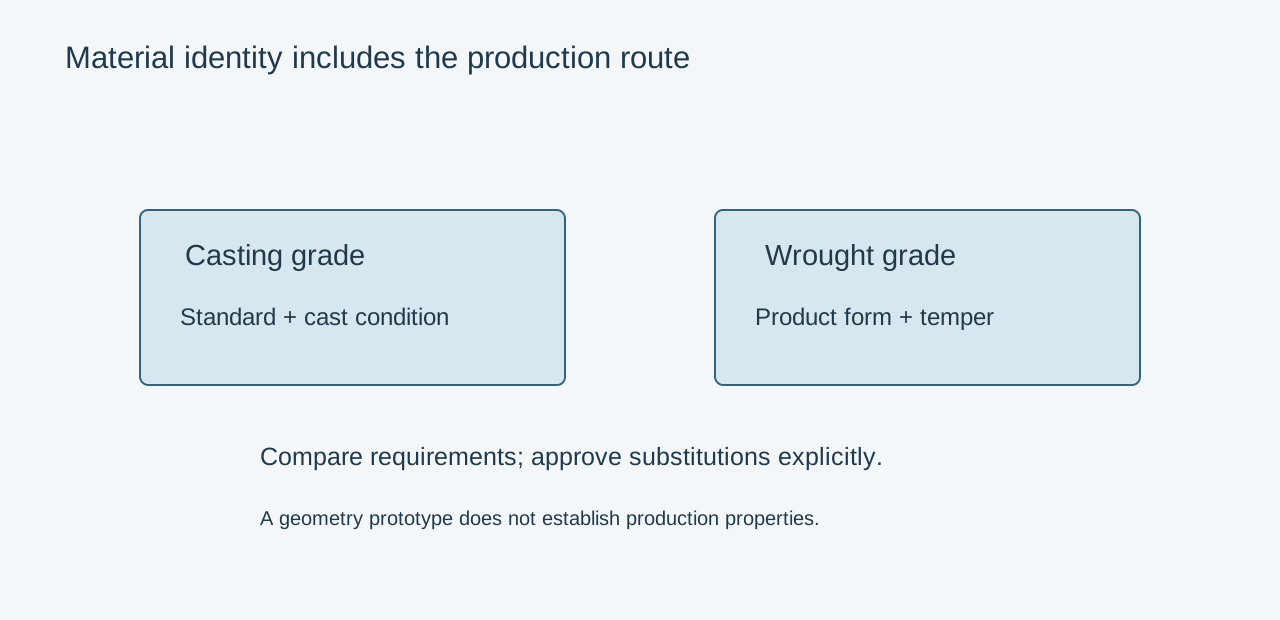
A380 belongs to the Aluminum Association casting designation system; ADC12 is a Japanese die-casting grade designation. Keep the exact grade, governing standard and required edition on the RFQ and purchase order. A supplier's internal material nickname cannot resolve two conflicting customer callouts.
Do not compare a typical strength value for one alloy with a guaranteed minimum for the other. Check the specimen, process and condition behind the number. Separately cast test bars and material cut from a thin housing wall answer different questions.
| Procurement question | Evidence to request | Approval decision |
|---|---|---|
| Which specification controls? | Drawing and order material callout | Resolve inconsistent names |
| Does the proposed heat comply? | Chemistry report with batch identity | Compare every specified element |
| Is a substitute proposed? | Written comparison against requirements | Customer engineering disposition |
| Does the finished part work? | Relevant dimensional and functional results | Accept the defined production condition |
Qualify the surfaces that matter
Material selection affects more than castability. A machined seal land needs suitable local soundness; a visible coating needs an approved appearance; a loaded boss needs the specified functional performance. Approve those requirements on production-intent castings. A chemistry certificate establishes the reported material composition, not the leak tightness of every delivered housing.
For example, suppose a drawing specifies ADC12 while the quotation offers A380 for a coated gearbox cover. The review should compare governing chemistry limits, the proposed casting route, coating samples and the finished leak test. A dimensionally correct 6061 prototype does not close those questions.
Control repeat orders
Record the accepted grade and any approved alternative in the order acknowledgment. Link incoming material records to casting and shipment lots. An alternative approved for one noncritical cover should not silently become the default for a different pressure-retaining housing.
Avoid unqualified statements that the two grades are identical, that one is always stronger or that either guarantees a particular corrosion result. When exact chemistry is contractual, use the purchased specification and current material evidence instead of a shortened online comparison table.
Related engineering decisions
- ADC12 vs 6061: Casting Alloy or Machined Wrought Aluminum?
- Anodizing Die Cast Aluminum: Feasibility and Finish Limits
- Related manufacturing service
- Read the broader engineering guide