

ADC12 and 6061 describe different material and manufacturing choices. ADC12 is a die-casting grade; 6061 is a wrought aluminum alloy whose product form and temper matter. Choosing between them is usually a choice between production routes as well as alloy names.
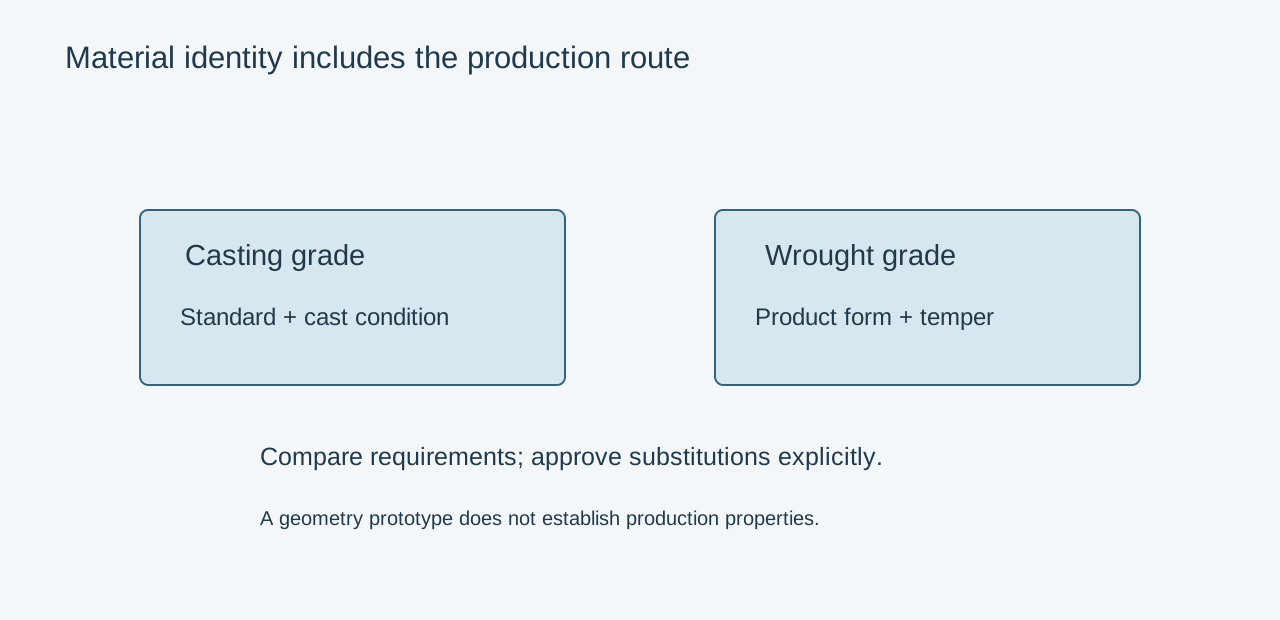
Begin with product form and condition
A 6061 plate, bar or extrusion is not interchangeable with an ADC12 casting. Specify the wrought stock form and temper for the machined option, and the governing casting specification for ADC12. Typical properties without a matching condition are unsuitable as finished-part guarantees.
| Requirement | ADC12 route question | 6061 route question |
|---|---|---|
| Complex repeated shape | Can it fill, release and remain sound? | How much stock and machining are needed? |
| Precision interface | Where is post-cast machining required? | Which setup controls the relationship? |
| Cosmetic anodizing | What does the actual casting achieve? | What does the specified stock and finish achieve? |
| Prototype validation | Are cast properties represented? | Which geometry or assembly question is tested? |
Separate prototype approval from production approval
A machined 6061 enclosure can establish board clearance, screw access and connector locations. It does not reproduce casting porosity, die parting marks, draft or finish response. If the production route is ADC12, approve cast samples for those questions after the geometry prototype has done its job.
The reverse also matters: a cast prototype is not automatically representative of a later machined wrought part if material condition or local performance controls the design.
Compare the complete functional route
For a ribbed electronics housing, casting can integrate supports that would require machining from a much larger stock envelope. For a simple plate-like bracket or a design with frequent revisions, machining from suitable stock may remain practical. Demand, qualification, surface requirements and product life determine the economic comparison.
If thermal conductivity, fatigue, corrosion or weldability drives selection, request data for the exact material, condition and route. Do not assign a general aluminum value to both. Define what must be demonstrated on the delivered component.
Send both the finished drawing and the intended production stage with the RFQ. Mark whether 6061 is a mandatory production material or only a prototype assumption. Resolving that distinction early prevents a geometrically successful prototype from being mistaken for approval of a different production material.
Related engineering decisions
- A380 vs ADC12: Differences That Matter in Procurement
- Die Casting vs CNC Machining: Choosing a Production Route
- Related manufacturing service
- Read the broader engineering guide