

Zamak 3 and Zamak 5 are zinc die-casting alloys with different strength, hardness and ductility tradeoffs. Zamak 5 contains more copper and is generally stronger and harder; that does not automatically make it the better choice for a feature that must deform during assembly.
Start with the assembly operation
A staked pin, crimped tab or riveted feature needs sufficient deformation without cracking. A loaded latch or threaded boss may put more emphasis on strength, wear and sustained loading. Compare the actual grade, supplied condition, service temperature and local section before selecting material.
| Requirement | Review for both grades | Evidence that closes the decision |
|---|---|---|
| Staking or crimping | Local strain and available ductility | Assembly trial on cast samples |
| Sustained load | Stress, temperature and time | Application-relevant creep assessment |
| Threaded connection | Engagement and boss section | Torque and repeated-assembly test |
| Visible hardware | Plating route and surface condition | Approved finished-part appearance |
Do not substitute from a strength table alone
Typical published alloy properties help with screening. They do not guarantee the behavior of a thin feature or the result after a particular finish. Compare values on the same test basis, and keep minimum acceptance requirements separate from typical data.
For an illustrative staked connector, replacing Zamak 3 with Zamak 5 may improve one load margin while making the staking operation less forgiving. The correct trial follows the production sequence, including coating and assembly. Passing a tensile test on a separate specimen would not by itself qualify the stake.
Design for the final dimensions
Both grades can be considered for detailed hardware with appropriate finishing. Define coating build, rack-contact zones and finished mating dimensions. A plated shaft or locating slot must be accepted after the deposit that changes its size. Avoid correcting an approved fit by uncontrolled polishing at assembly.
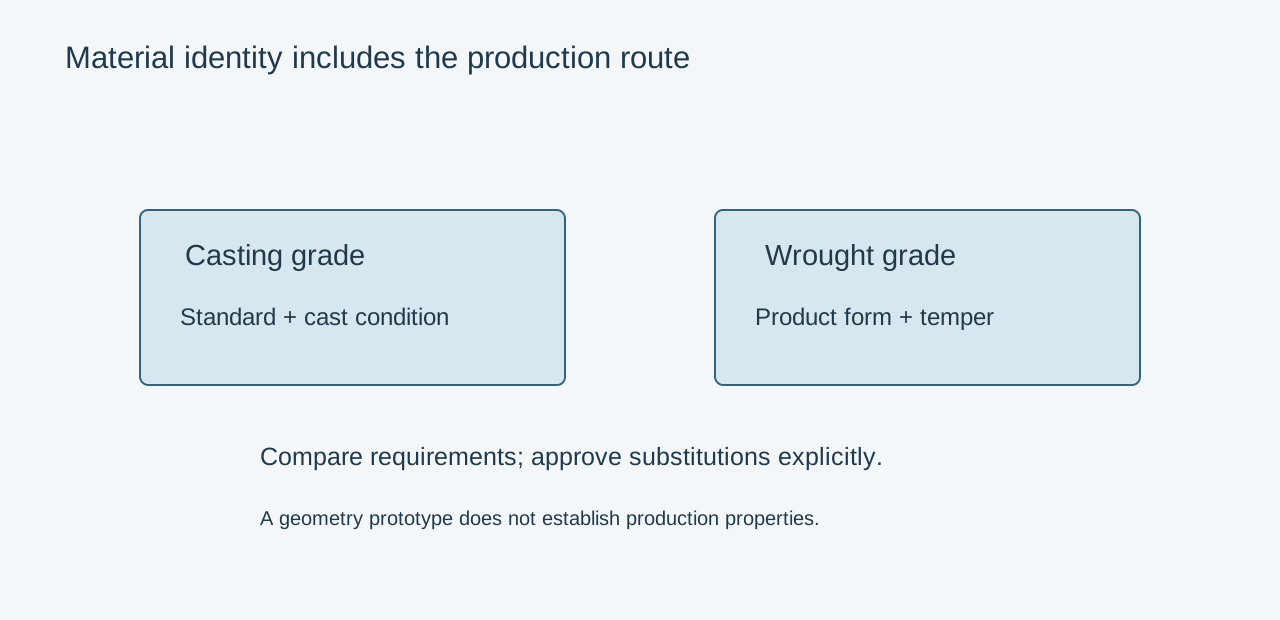
State the governing material specification and traceability requirement on the order. When considering an alternative, document why it is proposed and which dimensional, assembly and environmental checks must be repeated. Keep the discussion about zinc alloy 3 versus 5 tied to the component rather than calling either grade universally superior.
Related engineering decisions
- Screw Boss Design for Die Cast Components
- How to Choose a Die Casting Supplier
- Related manufacturing service
- Read the broader engineering guide