

A fixture for machining die cast components must locate variable raw geometry, support cutting loads and release a dimensionally acceptable part. Repeatability comes from the whole locating and clamping arrangement, not from clamp force alone.
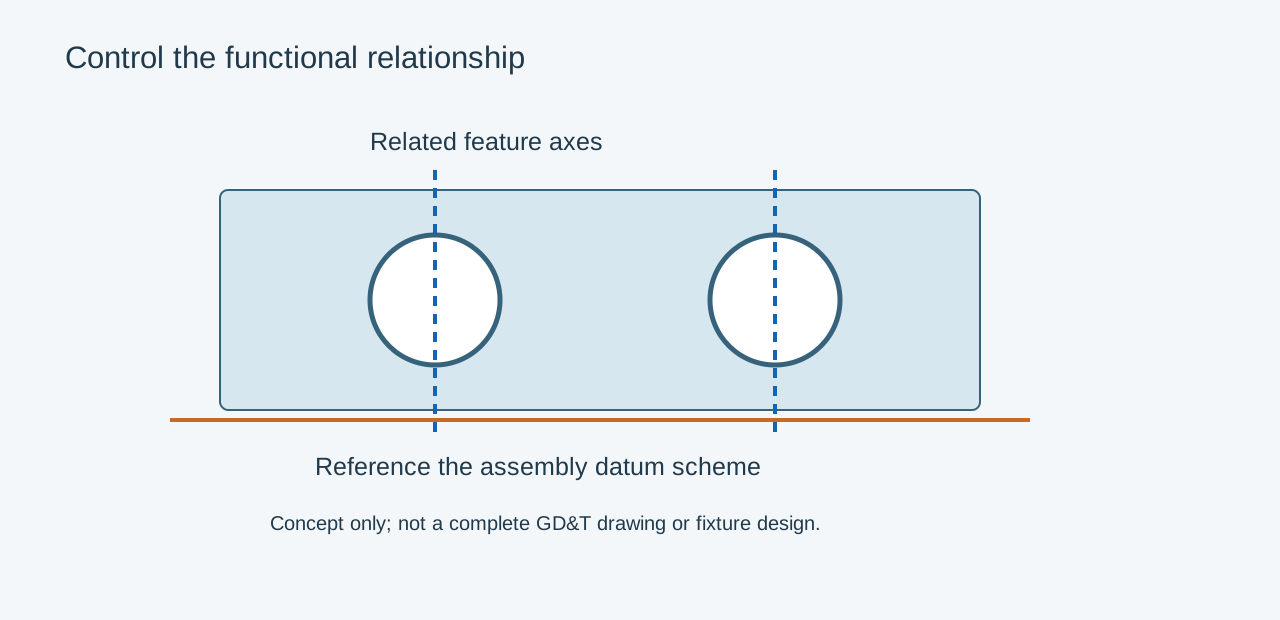
Separate location from support and clamping
Define which contacts establish position, which prevent deflection and which apply holding force. Extra contacts can overconstrain an irregular raw casting. A support that lifts the part before clamping can change the datum rather than improve rigidity.
| Fixture element | Design question | Trial check |
|---|---|---|
| Primary locators | Are they stable across casting variation? | Repeated unloading and reloading |
| Side location | Is draft or flash influencing position? | Compare actual contact areas |
| Supports | Do they resist cutting without moving the part? | Loaded and released measurements |
| Clamps | Is force applied through supported material? | Distortion and retention trial |
| Clearance | Can chips, coolant and burrs escape? | Production-like cycle and cleaning |
Include the raw casting envelope
Review the largest and smallest expected conditions at locating pockets, walls and bosses. Protect against parting witnesses or flash becoming unintended datum contacts. Provide practical access for loading, error prevention and confirmation that the part is seated.
For a first operation, raw pads may establish the location. Later operations can use machined datums. Document that transition and the relationship it controls; a second fixture should not quietly relocate the component from an unrelated casting surface.
Test distortion and repeatability separately
An illustrative thin cover may produce a flat machined face while strongly clamped, then spring away after release. Compare free-state, fixture-held and intended assembly conditions. Increasing clamp force may make the in-fixture result look better while worsening the delivered shape.
Run repeated loading trials with several identified castings, including representative variation. Check critical features after release and after any relevant finish. If different parts consistently shift differently, investigate locator contact and casting variation before applying program offsets.
Keep replacement locators, wear checks and cleaning in the maintenance plan. Chips under a datum can undo an otherwise sound fixture. Supply the raw and finished models, critical datum relationships and inspection condition together so fixture design answers the actual component requirement.
Related engineering decisions
- Machining Die Cast Aluminum: Planning the Complete Route
- CNC Machining Tolerances: How Tight Is Worth the Cost?
- Related manufacturing service
- Read the broader engineering guide