

Die casting becomes attractive when repeat demand can repay tooling and the casting removes enough machining or assembly work. CNC machining is often easier to justify while geometry or demand is changing. A production casting still commonly needs machining at bearing seats, seals and threads, so compare complete routes to the same accepted part.
Compare the delivered component
A billet prototype and a production casting can share an outside envelope without sharing material properties, internal soundness or finish behavior. Identify the approved material for each route. Keep load, leak, dimensional and cosmetic requirements equivalent before comparing prices. If the production design contains cast-in ribs or drafted pockets, the machined alternative may need a revised model.
| Decision | Machining from stock | Die casting plus machining |
|---|---|---|
| Geometry changes | Revise program, stock and fixtures | May require changes to hardened tooling |
| Material evidence | Wrought grade, temper and stock form | Casting grade and production condition |
| Repeated geometry | Material removal repeats on each part | Near-net shape repeats from the die |
| Precision interfaces | Cut in planned setups | Reserve stock and cut after casting |
| Qualification | Verify the machined route | Verify the casting and downstream route |
Calculate before choosing a volume threshold
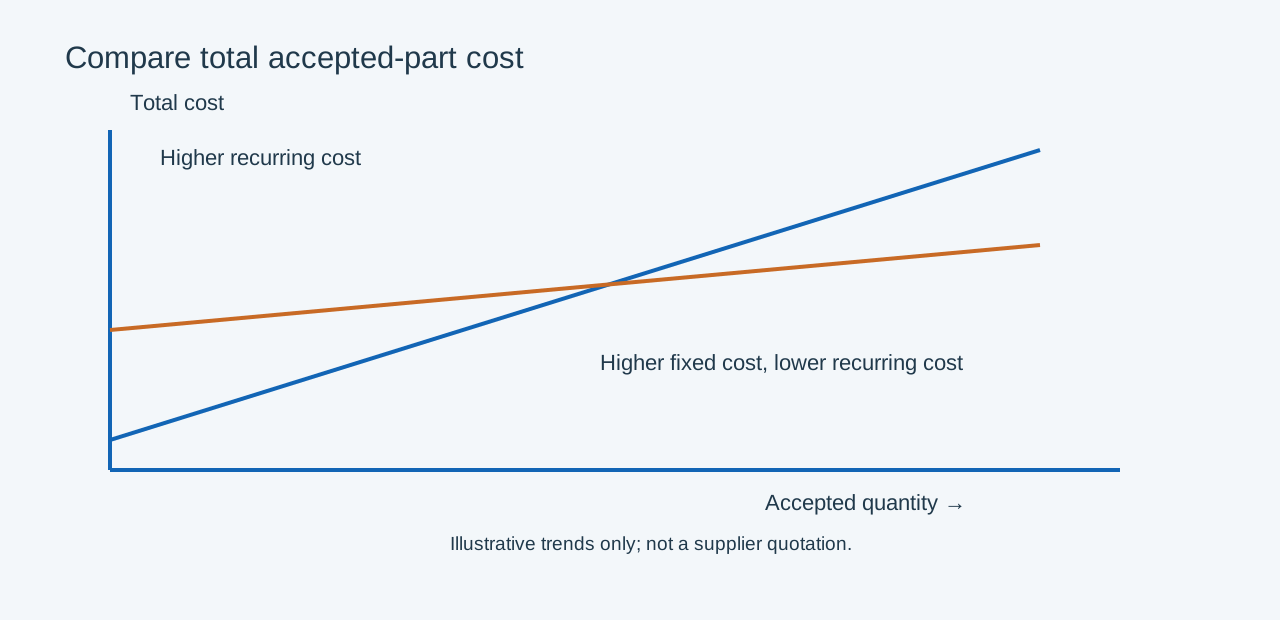
For an illustrative comparison, let machining require $2,000 of setup and $30 per accepted part. Let casting require $26,000 of tooling and validation and $10 per accepted finished part. Equal total cost occurs at (26,000 − 2,000) / (30 − 10) = 1,200 parts. These invented inputs explain the calculation; they are not ZAODA prices or a universal casting threshold.
The result changes if tooling needs revision, the finished yield changes or demand stops early. Run low, expected and high demand scenarios over a defined product life. Count freight, inspection, coating, maintenance and inventory on the same basis.
Use prototypes to answer the right question
A machined prototype can establish assembly access, connector position and fixture concepts. It cannot qualify how the production casting fills, ejects or behaves after machining. Keep the prototype approval separate from production-process approval. If demand remains uncertain, the cost of temporary machining may be less than the cost of revising an early production die.
Before requesting a route recommendation, send the assembly constraints, expected order cadence, material alternatives and critical features. Ask for a side-by-side process sequence rather than two unexplained unit prices.
Related engineering decisions
- Calculating the Break-Even Quantity for Die Casting
- ADC12 vs 6061: Casting Alloy or Machined Wrought Aluminum?
- Related manufacturing service
- Read the broader engineering guide