

Die casting minimum order quantity comes from the economics and operating requirements of a specific route. Tool setup, startup scrap, machining, finishing and packaging can all contribute. There is no single MOQ that applies to every component or supplier.
Ask which operation sets the minimum
| Source of minimum quantity | What creates it | Option to discuss |
|---|---|---|
| Casting setup | Tool installation and startup qualification | Defined setup charge |
| Material | Approved supply lot and handling | Shared planning where technically suitable |
| Machining | Fixture and program setup | Combine scheduled requirements |
| Coating | Batch, color and masking setup | Agreed finishing campaign |
| Inspection | First-off and required reporting | Explicit inspection scope |
| Packaging | Special materials or pack configuration | Standard versus dedicated packaging |
A casting machine may accept a small run while the coating route requires a larger economic batch. Compare the complete finished MOQ rather than assuming the casting quantity is the only constraint.
Distinguish samples from serial production
Trial samples support tooling and process approval. Their price and quantity need not represent repeat production economics. A small prototype order made by machining also does not establish the MOQ for the later casting route.
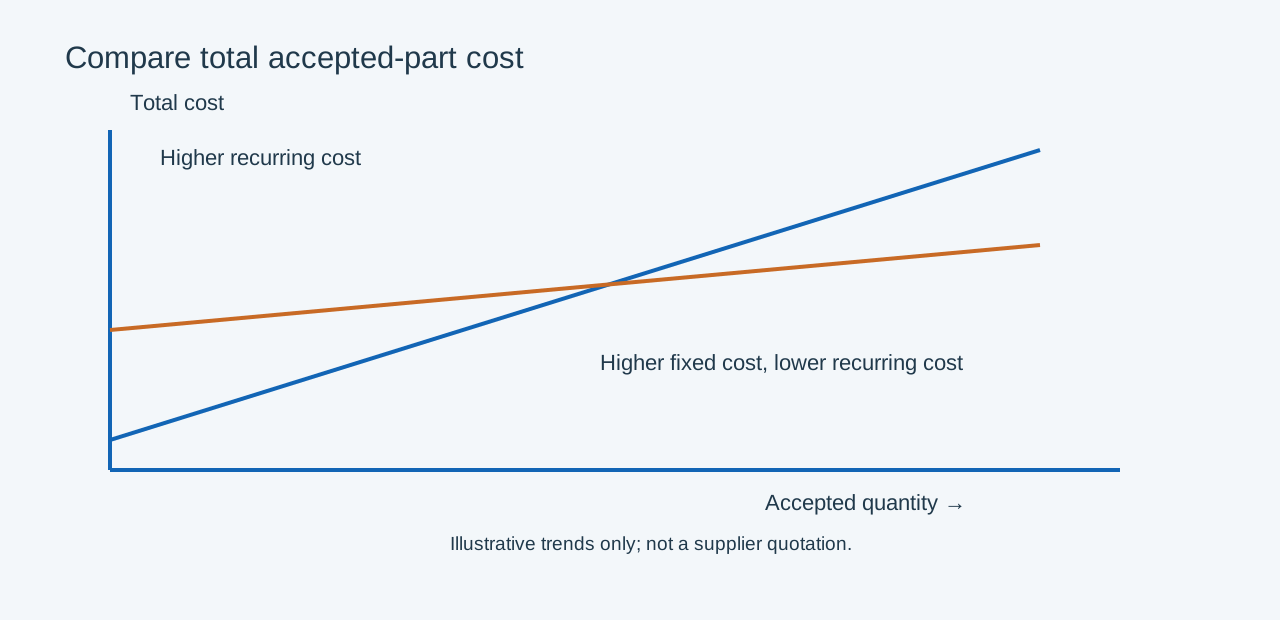
For an illustrative order, a $600 setup spread over 100 parts adds $6 per part before recurring work; spread over 1,000 parts it adds $0.60. These invented values explain allocation. They are not a ZAODA fee or a universal reason to buy more parts.
Compare inventory exposure with setup savings
Larger batches can reduce setup cost per part but increase cash tied up, storage, finish-aging concerns and the risk of a design change. Discuss a blanket order with scheduled deliveries only when responsibilities for production quantity, storage, payment and obsolete stock are clear. Smaller shipments do not necessarily mean smaller production batches.
Provide expected annual demand, release cadence, likely revisions and delivery requirements in the RFQ. Ask the supplier to identify the minimum economic batch and any workable alternative pricing. This makes MOQ a transparent planning decision instead of an unexplained number attached to a unit quote.
Related engineering decisions
- Calculating the Break-Even Quantity for Die Casting
- Die Casting Lead Time: From Tooling to Shipment
- Related manufacturing service
- Read the broader engineering guide