

Die casting lead time includes tooling development, trials, corrections, approval and the finished production route. A promised number of weeks is useful only when its starting point, scope and approval assumptions are defined.
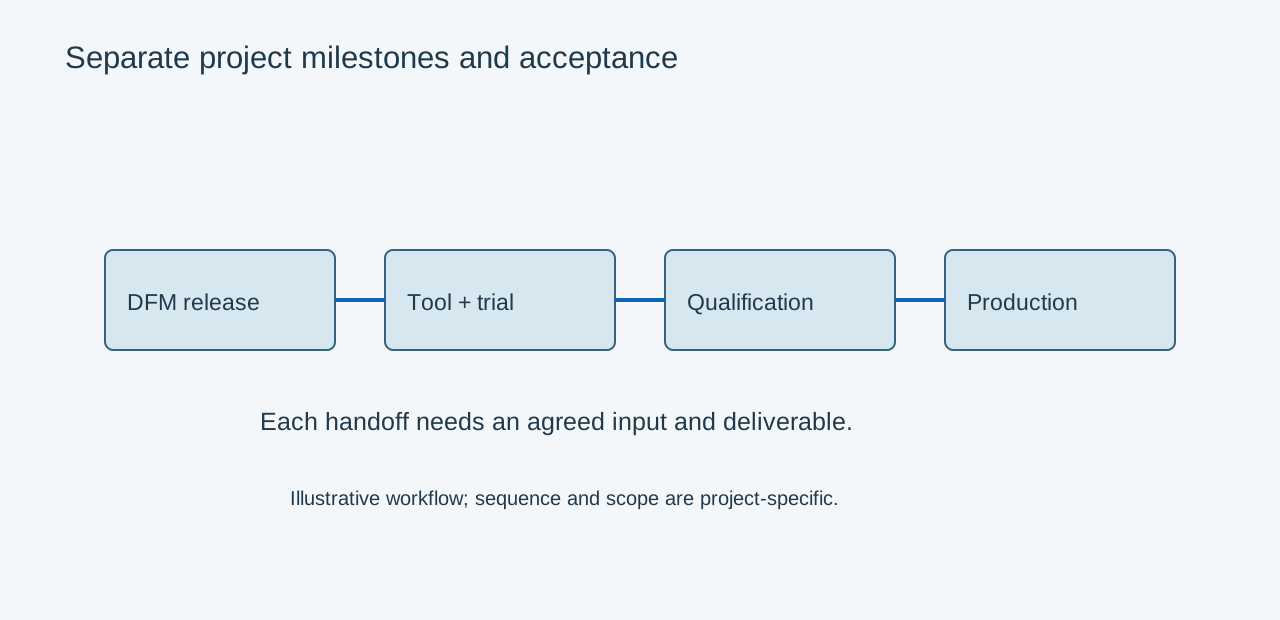
Separate development from repeat production
| Stage | Required input | Deliverable or release condition |
|---|---|---|
| Technical review | Controlled model, drawing and open issues | Agreed DFM and process proposal |
| Tool manufacture | Approved design and commercial release | Tool ready for the defined trial |
| Trial and correction | Identified samples and inspection | Disposition of critical findings |
| Production approval | Agreed dimensional and functional evidence | Authorized production revision |
| Finished manufacture | Material, capacity and approved route | Accepted machined and finished parts |
| Shipment | Packaging and delivery requirements | Released shipment and documents |
These stages can overlap where practical, but overlap does not remove dependencies. Cutting steel before an unresolved seal geometry is approved may move risk rather than save time.
Find the real critical path
A die can be ready while a special gauge, coating sample or mating connector remains unavailable. Include outside finishing, test fixtures and customer review time in the plan. Identify which operations need the approved casting before their own validation can begin.
For an illustrative schedule, the first samples arrive in week six but require a changed connector opening and a new appearance sample. Calling week six the “delivery lead time” would hide the remaining work. Report sample availability and production shipment as separate milestones.
Define what starts and stops the clock
State whether timing begins at purchase order, deposit, final drawing approval or tool-design approval. Agree how a customer revision affects work in progress and the forecast. For repeat orders, confirm tool condition, material availability, batch quantity and downstream capacity rather than copying the original development schedule.
Track decisions with an owner and due date. An unresolved inspection method can delay approval just as effectively as unfinished tooling. Keep trial reports linked to the exact drawing revision and cavity identity so corrections do not become repeated discussions over unidentified samples.
Provide required arrival date, order cadence, inspection scope and approval contacts with the RFQ. Ask for milestone assumptions and dependencies. This produces a schedule that can be managed instead of a single date whose meaning changes during the project.
Related engineering decisions
- Die Casting Tooling Cost: What Drives the Quote?
- Transferring Die Casting Tooling to a New Supplier
- Related manufacturing service
- Read the broader engineering guide