
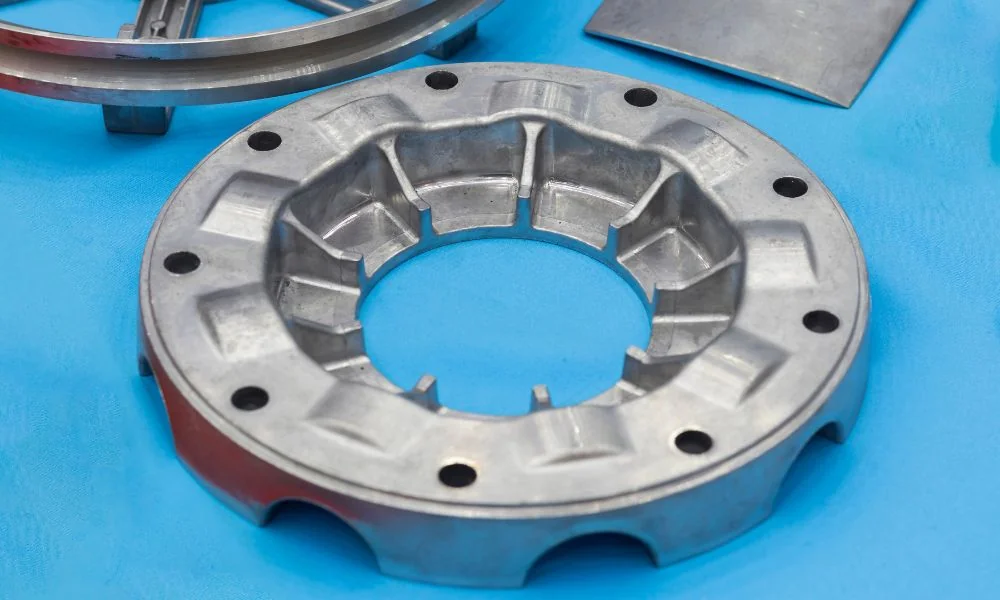
Die casting and sand casting differ in tooling, geometry freedom, surface condition and recurring production work. Neither process wins every volume or size range. Compare the complete finished component using a suitable alloy and qualification plan for each route.
Match the process to the geometry
High-pressure die casting uses reusable metal tooling and requires a workable release strategy. Sand molds are expendable and can offer different options for cores and internal geometry. A model optimized for one process may need redesign for the other; identical outside shape does not make the routes equivalent.
| Decision | High-pressure die casting | Sand casting |
|---|---|---|
| Tool commitment | Production die and associated actions | Pattern and core tooling as required |
| Revision | Changes may involve hardened steel | Pattern and core changes have their own costs |
| Section design | Filling, thermal balance and release | Feeding, solidification and core strategy |
| Finishing | Trim, machine and finish defined zones | Remove gates, clean and machine defined zones |
| Qualification | Verify actual cast and finished condition | Verify actual cast and finished condition |
Keep material and treatment comparable
A sand-casting alloy and a conventional die-casting alloy may have different chemistry and supplied conditions. A property value from a heat-treated sand casting should not be assigned to an unrelated high-pressure casting. If welding, thermal processing or particular mechanical properties are essential, include them in route selection from the start.
Compare total cost over credible demand
Include pattern or die cost, sample work, machining allowance, inspection, rejects and freight. Lower initial tooling cost does not guarantee lower lifetime cost, while a lower piece price cannot recover tooling if demand disappears after a redesign.
For example, an evolving large pump body with internal passages may justify a sand-casting review. A compact housing with stable demand and repeated mounting features may justify die casting plus precision machining. These are selection scenarios, not promises that either geometry is feasible without DFM.
ZAODA's core casting discussion concerns aluminum and zinc die casting; sand casting here is a comparison route. For an RFQ, provide the functional drawing and allow each proposal to identify necessary design changes. Compare the resulting accepted part and test basis, not only raw-casting prices or general claims about which process is more precise.
Related engineering decisions
- Die Casting vs CNC Machining: Choosing a Production Route
- Calculating the Break-Even Quantity for Die Casting
- Related manufacturing service
- Read the broader engineering guide