

Bearing fit tolerances in an aluminum motor housing depend on load, temperature, housing stiffness and the bearing arrangement. Selecting a bore tolerance from a general table without those conditions can cause ring movement, excessive deformation or lost axial freedom.
Determine what the ring must do
Identify whether the load is stationary or rotating relative to each ring, whether the bearing must move axially and how the outer ring is retained. Use the bearing manufacturer's guidance for the actual bearing and operating conditions. A locating bearing and a non-locating bearing can require different treatment.
| Input | Why it matters | Evidence |
|---|---|---|
| Load direction and magnitude | Ring creep and support | Motor load case |
| Ring and housing temperature | Operating fit changes | Thermal estimate and validation |
| Housing stiffness | Ring distortion and retention | Section and assembly review |
| Internal clearance | Fit can alter operating clearance | Bearing supplier assessment |
| Axial movement | Thermal growth needs accommodation | Complete bearing arrangement |
Include differential thermal expansion
For a simplified example, assume a 50 mm aluminum bore and steel outer ring start at the same temperature and both rise by 60°C. Using assumed expansion coefficients of 23 and 12 micrometres per metre per degree gives a differential diameter change of about 50 × (23 − 12) × 10⁻⁶ × 60 = 0.033 mm. These representative assumptions illustrate why temperature matters; they do not select a fit for a real motor.
Actual ring and housing temperatures may differ. The surrounding structure and bearing clearance also matter, so do not simply add the example's result to a room-temperature interference.
Specify geometry and measurement condition
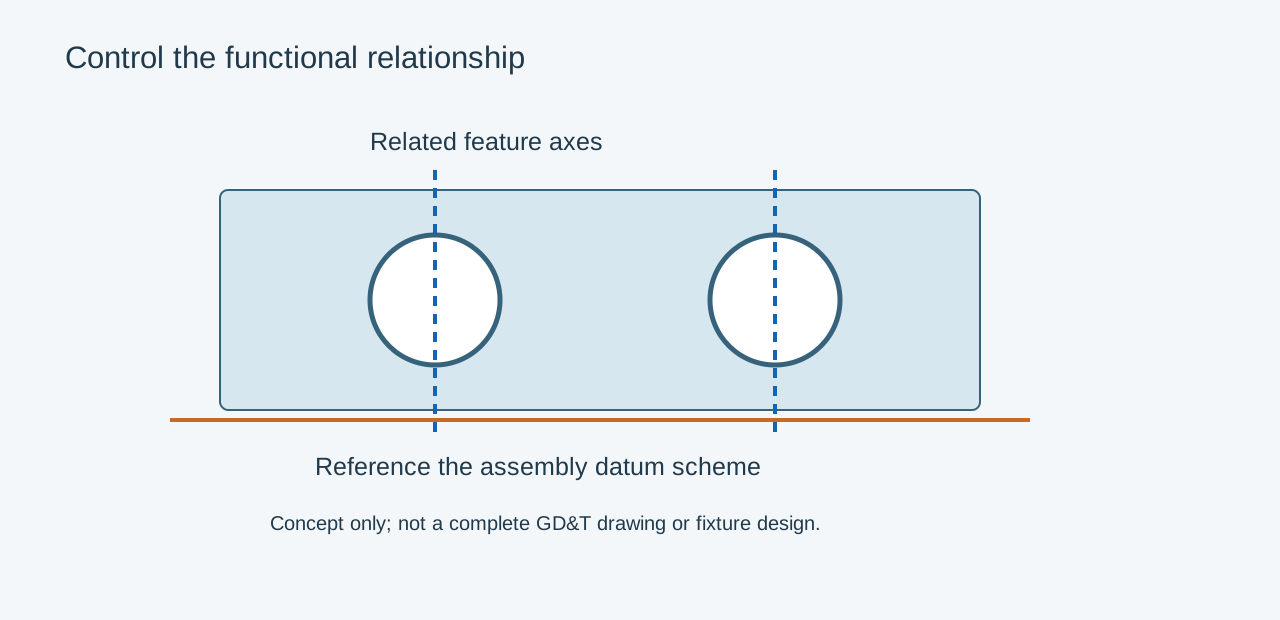
Bore size alone does not control roundness, cylindricity, shoulder geometry or alignment to the other bearing. Review machining setup and fixture restraint. A flexible end shield can measure differently when clamped, released or bolted to the motor.
Define final finish, inspection temperature and any assembly restraint. Validate retention, axial movement and bearing operation using production-intent housings. If adhesive, a sleeve or mechanical retention is proposed, evaluate that complete arrangement rather than treating it as an undocumented production repair.
Send the bearing designation and motor operating conditions with the housing drawing. That information is necessary to turn a tolerance callout into a defensible functional fit.
Related engineering decisions
- Aluminum Motor Housing Design: Key Manufacturing Decisions
- Die Casting Tolerances: How to Specify Functional Requirements
- Related manufacturing service
- Read the broader engineering guide